Showing posts with label Senior Studio posts. Show all posts

Thursday, April 8, 2010

Reading Response: Seven Days in the World

This week you're reading an excerpt Seven Days in the World. On your blog write a short personal response to what you've read. Any revelations? Surprises? Can you imagine yourself participating in a crit like the one described here?

I was really surprised to find how tense a crit can be. i was impressed that the artists were able to tell the crit group exactly what they were trying to represent and they were really the ones in charge of their own crit. the other artists really dont talk until they hear was the artist has to say about his/her work. thats awesome. this makes them understand the piece before completely judging it. i think that if we did crits like that, targeting specific questions, it would be more helpful. the only problem is, sometimes i dont really plan ahead and know the meaning of my own work. i feel like it just works itself out sometimes. i dont usually think, i just create and see where it takes me. I am not sure i can ever see myself participating in a crit like this. honestly, that kind of scares me. i would just be incredibly stressed out by it! plus, i dont see my work being at that level at all.

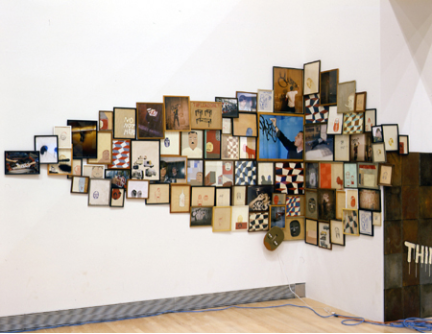
Critique : gallery piece

-could put pieces together in assorted order
- make all pieces different
-put portraits horizontal and vertical
- put in the shape of Africa
- dont put them all in a row
- dont structure it
-suspend them from fishing line - so u cant see the whole thing at one
- make wide enough for people to walk through them, or make an obstacle
make a box out of them
- make different shapes out of them


_____________________________
We met to critique again. I got feedback on my frame
- make pieces fall off of it
- have images be hanging from it
-make stuff come off of it so it looks more 3d
-off center portait in the middle

Sunday, April 4, 2010

Alternative Exhibit Formats Response


I really like the way Lorna Simpson and Barry McGee exhibit their art work. I love the way Simpson doesn't put her pieces in a structured way. I want to mimic that style when I set up my work for the gallery. I also like how McGee layers his pieces. And how he uses the space (corners) to display his work. REALLY cool. For my gallery piece, I want pieces to be both flat on the wall and stick out of the wall. Maybe I will layer some like McGee does.

Reading Response: The Critique Handbook

In your opinion, what do you think the role of the critique, as it's described in this chapter, could be in a class like ours?
The role of a critique is described as a daunting judgement day for art students and subjective. I feel like in our art class it is more relaxed and is constantly happening. When I am stuck with my work or just finished something and want an opinion I look to my peers and teachers to advise me and critique my work. It is not scary, just helpful. And as an artist, you can have selective hearing, and can pick and choose what to use from the advice you receive. Don't loose yourself in a critique though. You need to keep the work your own. Don't completely change your vision if someone else tells you to move in the opposite direction. It's all about having a balance.

According to this chapter and your past experiences, how can you get the most out of a critique of your own work?
articulate where I want to go with my unfinished piece, what I was trying to do, and what I want to do. My artist intentions. This way my peers can understand and interpret my work from the angle I was trying to get at. Also write things down. makes everything so much easy to remember. When you are getting a critique, there is so much feedback that it can be hard to remember it all.

How can you be a helpful participant in your classmates' critiques?
Give them my ideas. Be honest without being harsh. just saying "that's good," doesn't help. GIVE FEEDBACK. or point out specific details that worked. be specific, not broad and ambiguous.

Friday, March 12, 2010

Reading Response: Art & Fear

"The fear that you are only pretending to do art is the (readily predictable) consequence of doubting your own artistic credentials."

Sometimes when I do work that turns out good I think that it is just luck. It can be especially bad when the next piece of art I produce is not so good as the one that I did before. It can make me doubt my skill as an artist.

"If you think good work is synonymous with perfect work, you are headed for big trouble. Art is human; error is human; ergo, art is error."

I often struggle with art when I am just beginning a new project. I do a lot of portraits, and usually I start them with a gesture drawing that is just composed of a bunch of scribbles. I know that it is supposed to be a bunch of scribbles. I still find my self chucking the gesture and starting over. It needs to be perfect on the first try for me, I don't usually find my self completely reworking piece even though I should be. I would probably make better art that way.


"But while others' reactions need not cause problems for the artist, they usually do. The problems arise when we confuse others' priorities with our own."
I usually have an idea in my head of what I want to create, or I happily stumble upon it. Sometimes what other people think I should do interrupts that.

Tuesday, March 9, 2010

Response to Tharp reading

The general problem that I can see myself facing during senior studio is being too structured instead of just going with the flow. Tharp talks about how artists sometimes focus on big ideas and how from there it can be hard to construct good creative ideas. I feel like this was becoming an issue for me as an artist as well. I came into the class with a picture of what I was going to do. Something like this can get an artist into "trouble" creatively. When I sat down to try and illustrate my big awesome idea, I became frustrated. It was too big of an idea and I did not know where to start. I wanted to create a big mural of my friends, my sports teams, my general high school experience. HOW DO YOU DO THAT? WHERE DO YOU BEGIN? I feel like using Tharp's method of scratching," digging through everything to find something," would work for me. I began to feel inspired, scratching through an excerpt of her self help book. Maybe if I broke high school down into mini events and big moments I could truly find my creative spark and get the ball rolling. I began this with my A2D art project where I unwillingly created 25 notecards branched off of the main theme of high school. From there I began to see what events and types of art I really wanted to throw myself into. Coming into the class with a huge structured image of what I wanted my art to be was not the right approach for me. Each person, as Tharp points out, gets there inspiration from different places and different things.


Tuesday, March 2, 2010

Studio Space

The artists' studios were all different. Most of them looked really cramped and had limited space. Most artists had books and inspiration on the walls. They also had their old work on the wall.

Usually, the bigger the canvas that the artist uses, the bigger the space. It also influences whether or not the artists uses a table, easel, or the floor to work.

As an artist, I like a lot of table space and like to spread out when I work. I also like to have a lot of materials and pictures around me when I work.